

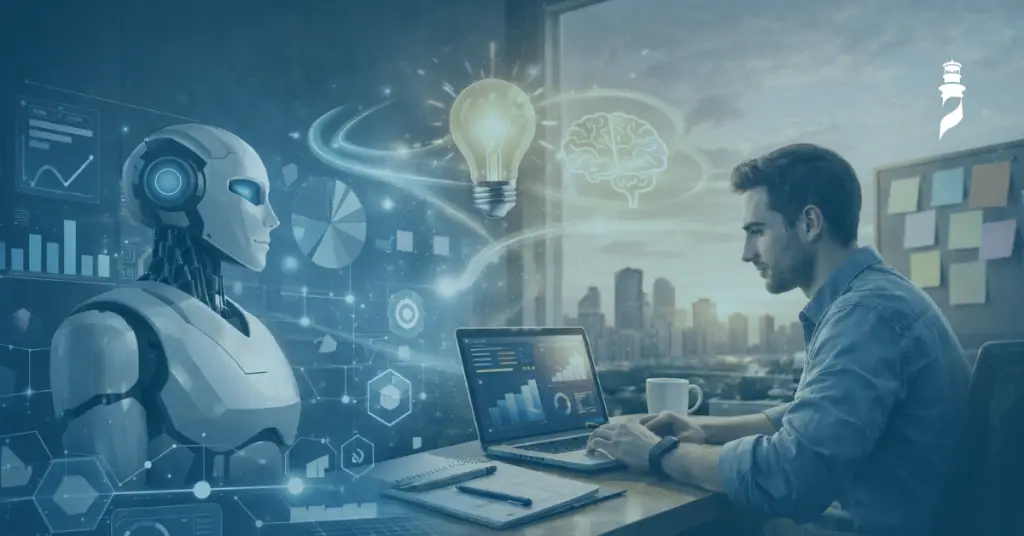
Why Everyone Thinks AI Can Replace Marketing
AI is everywhere in marketing right now. Tools can write posts, design images, and even generate campaigns in seconds. Because of this, many businesses are asking the same question: Do we still need a marketing team?
The truth is more nuanced. AI vs human marketing is not a competition. It is a collaboration problem. Companies that remove people often see inconsistent messaging, weaker brand identity, and poor performance tracking.
In this article, you will learn where AI helps, where it fails, and how to structure a modern marketing function that actually works.
The Real Problem: Marketing Is Not Content Creation
Many businesses believe AI can replace marketing execution because it produces content quickly and cheaply.
The problem is that marketing is not content production. It is decision making.
When companies rely only on AI:
- Messaging becomes generic
- Brand voice becomes inconsistent
- Campaigns lack direction
- Metrics exist but insights disappear
AI removes effort, but it does not create strategy.
This leads to a hidden risk: companies publish more content than ever but perform worse than before.
How to Actually Use AI Inside a Marketing Team
- Use AI for speed, not decisions
AI should generate drafts, options, and variations. Humans should choose direction, tone, and messaging.
- Keep humans responsible for strategy
A marketing team defines audience, positioning, and priorities. AI cannot understand business context or trade-offs.
- Let people interpret performance data
AI produces analytics dashboards. Marketers turn them into actions. Insight requires business understanding.
- Combine automation with accountability
Assign owners for campaigns. AI tools assist them but never replace responsibility.
- Build workflows where AI assists every stage
Research → ideation → drafting → refinement → analysis
AI supports each step, humans guide the outcome.
What Happens When Companies Remove Marketers
Example 1: Content volume vs results
Companies using AI alone often increase output but see declining engagement due to generic messaging.
Example 2: Brand voice breakdown
When multiple AI prompts create content without oversight, tone shifts across channels and reduces trust.
Example 3: Human-guided AI performance
Businesses that combine human marketers with AI tools produce fewer pieces but higher performing campaigns because messaging aligns with strategy.
Industry insight: AI increases productivity, but performance improves only when humans supervise and interpret.
Best Practices and Pro Tips
- Define a comprehensive brand identity and value proposition before using AI tools
- Always edit AI output before publishing
- Use AI to brainstorm, not to finalize messaging
- Assign one human owner per campaign
- Track business outcomes, not just impressions
- Train marketers to prompt AI correctly instead of replacing them
The Future Is Not AI or Humans. It’s Both
AI is powerful because it accelerates work. Marketing is powerful because it guides decisions. The strongest businesses combine both.
AI handles repetition, drafting, and data processing. Humans handle positioning, judgment, and accountability.
Companies that replace marketers with AI produce more but achieve less. Companies that empower marketers with AI produce smarter campaigns and clearer growth.
The Future of Marketing Is Clarity, Not Noise
There will always be faster tools.
There will not always be clearer strategy.
The businesses winning with AI are not replacing people. They are empowering them. They publish less noise, make better decisions, and understand why their marketing works.
That is what modern marketing should feel like. Calm, consistent, and measurable. If that is the kind of marketing you want, take a look at how we help businesses build it. Contact us for more info


